Thursday, October 26, 2017
How to Identify Genuine Amber
I've been asked on a couple of occasions how to identify genuine amber beads on tribal pieces. The first question I ask is always “how much did it cost?” because genuine amber pieces, in the sizes used on tribal jewelry often run into the thousands of dollars. I hope the information given below is more helpful in making a determination!
First let's define "amber". What most of us think of as amber comes from fossilized tree resin. Amber is found on the sea floor or washed up on the beach or it is excavated in mines. “Real” amber can be from 30-95 million years old. Amber ranges in transparency from perfectly clear to almost entirely opaque and in color from white to black, including green, red, blue, yellow, brown and orange. Since it basically originated as tree sap, it may sometimes contain animal and plant material. These are known as “inclusions”. No one knows how much amber there is on earth. Some sources say there is probably much more gold on Earth than amber.
Types of Amber
Genuine Amber - This is a term that includes natural amber and pressed amber. Both are 100% amber with no additives. Heat will soften raw Amber and allow it to be molded and shaped. This process of slightly heating amber to make it malleable is common and does not change its magical properties. Hand-Carved or faceted amber is very expensive, but molded amber is more affordable and is still considered genuine. Most people consider only Baltic amber to be “genuine” but in truth, genuine amber is found around the world.
Pressed amber is made from small pieces and rejects that are melted together under high pressure. It is generally even in color. Smaller pieces of high quality pressed amber are difficult to distinguish from natural amber except that it is almost always uniform in shape. Beads and the settings in most jewelry are pressed. This is because pressing gives manufacturers uniform pieces that can be used in production and helps keep costs of the finished product to a minimum. Pressed ambers will often look different than natural amber and will be a bit more dull. Pressed amber can pass most of the tests for genuine amber.
Ambroid is a product made up of small pieces of amber embedded in plastic. The plastic is colored so that most people do not know that it is plastic. When people buy low cost jewelry often what they are getting is ambroid. It contains chips so is passed off as amber, but it is really just plastic with amber chips in it.
Copal is kind of a catch-all term used to describe beads made from young tree resin or a young amber. It can be made from the resin of any of a variety of trees. Tree resins are sometimes used to make a varnish that copal beads are treated with as a finish. It is sometimes called imitation amber and is usually easily identified.
Imitation amber is also made from plastics and colored glass. Many times bakelite and other synthetics are mistaken for amber.
Testing for Amber
There are several ways to test for amber. But there is no substitute for knowing your jewelry dealer or knowing the feel and weight of real amber. True amber never really gets cold. I've even heard you can put it in the refrigerator and it won't feel cold when you take it out! Also if you are sensitive to weights, the weight of real amber is less than other gemstones or glass.
Before choosing one of the following tests it is important to keep in mind that some of them might leave marks or mar or even ruin your amber. So if you are testing an expensive amber piece it might be a good idea to choose one of the safer tests. It is also worthwhile to pay attention to the price. If the item is priced much lower than most, this is a good indication that it may be a fake. Alternatively, before you purchase, you may want to request that the seller provide a certificate of amber authenticity.
Pin Test
A red hot pin poked into the object will make a piney-smelling smoke. Keep in mind that amber will also burn. Obviously this test will mar your amber piece! But it is also a pretty foolproof way to tell if it is genuine.
Look for defects
Generally speaking, natural amber will almost always have some sort of defect, ie; bubbles, dirt, crazing, or variances of color within a single piece.
Drop it in salt water.
Natural amber will float when dropped into salt water. Mix water and salt, 3 parts water to 1 part salt until dissolved. When you drop your beads in, amber will rise to the top. Glass and plastic will sink.
UV Light Test
UV light is supposed to be a very good testing method. If you shine a UV light on genuine amber, it will glow pale and fakes will not glow at all. There are some things to consider - not all ambers will glow a lot, certain colors like red often will not glow but if you move the light around the entire piece you will find a glow spot.
Acetone Test
If you put some drops of acetone (or some type of agent like this, say nail polish remover) on the item, real amber will not be affected after the acetone evaporates, but plastic will be sticky. You can even drop muratic acid on amber and it wont hurt it. Be aware that acetone will leave spots and defects on copal and synthetics.
Scratch Test
Amber is softer than most gemstones, it will scratch. Most hard fakes will not.
Rub and smell
You can also rub the specimen vigorously on a soft white cloth. True amber may start to smell of a resinous piney fragrance. Copal will also give a scent when rubbed, but it is not as strong as natural amber and I have heard there is a difference in the actual smell, although I do not have personal experience with this. With too much rubbing, copal will begin to soften and the surface become sticky.
You could also take the piece to an amber merchant you trust and they may be able to tell you by looking at the piece whether they believe it to be genuine amber.
I hope this helps you identify what your piece is made of without too much difficulty!
Links you might find fun or useful:
Six tests for identifying amber -
http://www.thenaturalamber.com/blog/6-amber-tests-identifying-real-amber/
Ancient carved ambers in the Getty Museum
http://museumcatalogues.getty.edu/amber/intro/4/
Amber Gemstones
https://www.thespruce.com/amber-gemstone-jewelry-for-you-1274601
Colors of Amber
http://www.thenaturalamber.com/blog/different-colors-of-amber/
Palanga Amber Museum, Lithuania
http://pgm.ldm.lt/en/home
This blog shows some different amber opacities and has good info
http://blog.hunterridgejewelry.com/2014/05/10/how-to-tell-real-amber-v-fake-amber-jewelry-and-everything-in-between/comment-page-1/
Wednesday, October 4, 2017
Cowrie Jewelry in India
Cowries as a Form of Currency
Cowries are found in the Indian Ocean near the Maldives, the Laccadives and around Zanzibar. They washed up in quantity on the shore and were gathered, and at times were cultivated by the local peoples. Cowries have been used as currency on every continent except Antarctica! Cowries became convenient form of currency because they were small, portable, long-lasting and hard-wearing, mostly uniform in size/shape and were hard to counterfeit. Traders from near the Indian Ocean spread cowries across the ancient world, from China to Eastern Europe. Cowries were used not only as currency, but as personal decoration in India, Africa, the Middle East and all across Asia and Oceana. Cowries were worn in ancient Egypt and have been found in Siberian graves as well as cro-magnon graves in Eastern Europe.
Besides being a small and portable form of money, the cowrie symbolized women in many cultures. The shape of the shells is thought by many to resemble female genitalia and so encompasses the concepts of female sexuality and human fertility. The cowrie is also hermaphroditic which makes it appear to magically self-multiply, contributing to it's use as a fertility symbol. It recalls the basic sexuality of human kind and epitomizes the potency of sex, transcending boundaries of culture, religion and decency. In some cultures, it is also thought of as bearing a resemblance to the human eye, so like the eye bead and mirror, it repels the evil eye and wards off demons. Because of it's almost indestructible nature and it's glossy white surface, the cowrie also came to symbolize immortality.
Because of its associations with sexuality, fertility, wealth, immortality and protection, the cowrie shell is one of the most common and powerful amulets to be found. It is used everywhere and decorates everything from amulets, pendants, jewelry, clothing, household items, musical instruments and animals.
As currency, it has been one of the longest and most widely used forms. Cowries were in use in China as early as 2,000 BC and were used up until 1940 in some areas of Africa. In some eastern parts of India (Bengal and Orissa), they were used up until the 19th century as a form of low value currency.
In India, the use of cowries for exchange gradually diminished with the wider use of metal currency issued by the British. The shells then plummeted in value and were impractical for use as currency. Cowries had always been used for other purposes, but their monetary connotation and ready availability lead to their decorative use as a symbolic display of wealth on the human body, animals or on utilitarian objects.
![]() |
| Cowrie Tassels on Banjara Armlets |
There is little written about the use of cowries in Indian personal and tribal adornment in reference works other than in general terms. They are sometimes mentioned as a natural form of adornment and sometimes there is discussion of their powers of protection. Much more, however, is written about the powers and necessity of bodily adornment itself, usually (but not always) framed in terms of precious metal jewelry. In fact, many reference works skip over jewelry composed of other materials completely and concentrate exclusively on that of precious metals. One can hardly blame them. The quantity and variety of gold and silver from India is almost unbelievable.
Indian jewelry and adornment can indicate religion, geographic origin, social and economic status, wealth and marital status. Dowries, both of Hindu and Muslim women,were usually made up of traditional silver or gold and provided by the bride's family. As basic background, until relatively recently Indian women could own only their jewelry as property. Most of her jewelry was provided at marriage and a specific amount, in weight, was proscribed by a written marriage contract. It was her sole material security. All other material wealth was owned by men.
In general the oldest tribal amulets are those found in nature, such as teeth, fur, bones, horns, feathers, shells, seeds, etc. As one of nature's oldest and most treasured amulets, cowries have found their way from coastal areas into the most remote parts of India. These old talismans have been used for over 2,000 years and are still in use by tribal and rural peoples today, especially in the “tribal belt” of India – from the Arabian Sea in the west running through central India to the Bay of Bengal in the east.
All traditional tribal jewelry acts not only to make its wearer beautiful, but also as protection from spirits, the evil eye and misfortune. Bodily adornment provides the most powerfully expressive elements of Indian tribal art, followed closely by domestic adornment. For thousands of years, cowries represented human sexuality, fertility, an eye or female genitalia. Cowries can be attached to almost anything and with the open cleft side visible can be made into attractive, decorative and repetitive patterns. From ancient times cowries were used as animal decoration as well as human, and the custom of adorning valued animals symbolizes human dependence on their stock and the value placed upon cattle, horses and camels. It is little wonder then that the cowrie became a ubiquitous element in tribal art forms.
![]() |
| Naga Warrior |
Tribal Groups Using Cowries for Adornment
There are many different Indian tribal peoples that use the cowrie in their jewelry, clothing and everyday items. “Adivasi” is a general name that covers the original small, autonomous groups of rural tribal people found across modern day India who do not necessarily belong to any Hindu, Muslim or Christian religion. All use cowries as elements in personal and household adornment. Generally Adavasi women are equal in rights to men and can choose their own spouse. They do not bring dowries to a marriage.
Banjara tribal people (also known as the Lambada or Lambani) were originally nomads but are now more settled and have become road builders. The women wear magnificently embroidered clothing and heavy silver jewelry, even when doing manual labor. They add cowries to the edges of blouses and hems of skirts as well as incorporating them into tassels and jewelry. The Romany people are said to have come from Banjara forebears. To the Banjara, cowries represent Lakshmi, the goddess of prosperity. The Banjara women are holding tightly to their ancient modes of dress, which are said to be the most colorful and elaborate of any tribe in India. Much of the modern tribal belly dance costuming tradition originated with Banjara jewelry and textiles.
The Rabari are another well-known tribal group that use cowries in personal adornment. They are camel/livestock breeders, and some still travel the ancient routes between winter and summer areas. Most are now living a more settled life in Gujarat, the Punjab and Rajasthan. The Rabari have their own unique artists' traditions, including fabric stamping, embroidery and applique work. The women pursue embroidery, beadwork and other crafts, and make clothing and household items. Rabari men make animal trappings and bags. These include halters, girths and elaborate neck decorations, called gorbandh, that are decorated with buttons, tassels, mirrors, pendants and cowries. These are made and decorated to beautify and protect their most valuable possessions – their camels! Gorbandh are elaborate, and emcompass halter, bridle and “necklace” all in one, often reaching from the camel's head to it's knees. The Rabari are one of the most photographed tribal groups because of their striking dress and jewelry and their more accessible geographic locations.
One other Indian tribal group I will mention here is the Naga. Originally headhunters from ancient times, the Naga live in the most easterly part of India, on the other side of Bangladesh, in an area appropriately called Nagaland. Ancient Naga culture survived almost intact into the mid-twentieth century, including the practice of headhunting. They were fundamentally self-sufficient in essential needs, and were one of the last groups to be in contact with the British. Their spiritual beliefs tended toward animism, and they practice a primitive and superstition-based religion. There is no evidence of influence by the Hindu or any other outside religion. Most materials for their personal adornment come from local, natural, accessible sources. In this group, cowries are oddly used to denote men of warrior status. Cowrie wristlets represent the drawing of blood. In various configurations, cowries are used on men's loincloths and various personal items. They are not generally associated with women in this culture. For the Naga, cowries are a display of wealth and status.
Obviously the cowrie has a long and rich history in India and across the world. It's staying power is evidenced by the fact that it is still used today to adorn, decorate and beautify it's wearer, whether human or animal. As a renewable resource it is one of the most ecological adornments in use. It has played a large role in and made a great contribution to India's history, both as a currency and decorative element. For tribal people, the use of cowries is such an old tradition that often the original meanings and purposes have often been forgotten and can't easily be explained by their wearers!
![]() |
| Banjara Women in Tribal Finery |
Bibliography
Websites:
Websites:
Shells as Money
The Adivasi
The Rabari
Naga Culture
Books:
Amulets – Sacred Charms of Power and protection by Sheila Paine
Naga Tribal Adornment by Shilu Ao
Tribal Asia-Ceremonies, Ritual and Dress by Robert Schmid and Fritz Trupp
The Splendor of Ethnic Jewelry by France Borel
Ethnic Jewellery-From Africa, Asia & pacific Islands by Oppi Untracht
Traditional Jewelry of India by Oppi Untracht
Wednesday, June 10, 2015
Central Asian Tillya Kosh
Tillya kosh, or tilla kosh as it is sometimes written, are some of the most beautiful items of personal adornment that I know of. These lovely bridal headpieces originate in Uzbekistan, specifically in the areas of Bukhara and Samarkand. The name itself has been translated to mean "golden brow" perhaps because they are usually made of a golden colored metal. Older pieces have been found that are made of true gold, but later pieces are gold leaf or even base metals.
The jewelry of Uzbekistan has traditionally been lavish and amazing to look at and tillya kosh are no exception. The lovely shape of the tillya kosh is meant to mimic the shape of a woman's brow line and embodied the goddess Anahita (Umay).
Originally tillya kosh were decorated with jewels and precious stones set into the upper scrolling crown and dangles of gold and perhaps pearls along the bottom. Most often the design incorporated a line of turquoise stones which symbolized both the celestial sphere and water.
![]() |
| Tamara Khanum, first woman to perform without the veil in Uzbekistan |
The origins of the design have roots in many different areas, cultures and times - Tajikistan, Persia and India, the Buddhist and Islamic religions, and the changes and ideas that these cultures brought to the region.
Like most forms of traditional jewelry, tillya kosh are still being made today, although the materials used may be different. Even European jewelry designers have borrowed this flattering shape to make their own creations that echo the traditional designs.
![]() |
| European Diadem |
It is still sometimes possible to find fine old pieces today, but they are quite expensive and difficult to locate. New pieces in less expensive materials are sometimes available at more affordable prices if you keep your eyes open for them.


For further reading, please see:
Jewelrs Magic - Like Art
Tillya Kosh Bridal Forehead Decoration
Comparative Analysis of Head Jewelry of Europe and Central Asia
Buddhist Tradition in Tajik Jewelry
More in depth info on women's costuming:
The National Costume of Samarkand Women at the end of the 19th - 20th Centuries
Tuesday, November 26, 2013
Fibula – What Are They? Where Do They Come From? How Do I Wear This Thing?
![]() |
| Moroccan Fibula in the Kabylie Style |
If you have seen North African folkloric dancers, you may have seen them wearing a curious looking pin with a ring or “C” shape around it on their costuming. Or maybe you have seen renaissance faire characters with these items on their cloaks. If you aren't familiar with authentic period costuming, you may never have seen one of these pieces up close. The have a long history, can be quite beautiful and lend an artistic touch to dance costuming or even everyday wear.
There are several different designs that are called 'fibula' but basically consist of a long pin with an attached piece of heavy wire or decorated metal in a “C” shape. Fibula can be single pieces or pairs. Fibulae is the plural form of the word. They can be plain or quite ornate and often have chains or pendants attached. Gems, enamel work, and designs of any and all kinds can be found on these lovely pieces. They can be made from almost any metal, and sometimes other materials, including bronze, iron, ivory, silver, gold, and even bone. Usually worn at the shoulder or shoulders, they are often thought of as the original safety pin!
![]() |
| Catch style fibula from Asia Minor |
Fibula have been found that date to as early as the bronze age. Quite popular with the ancient Romans who borrowed design from the Greeks and Etruscans, their use was spread throughout the world as Rome extended it's rule. The use of fibulae was supplanted by the invention of the button in the middle ages, but there are some cultures that continued its use still use fibula today as part of their culture. As a form of art there is nowhere in the world that boasts such ornate fibula as North Africa.
The North African style of fibula are worn by pushing the pin through two or more layers of fabric, then turning the ring to hold the fabric and pin in place. Many dancers continue to use these beautiful items to adorn forlkloric and tribal costuming.
Anthropology Blog with info on fibula:
http://soa111.wordpress.com/2011/01/16/fibula-brooch/
Roman and Greek Jewelry:
http://www.theartofmakingjewelry.com/Roman-jewelry.html
The Red Camel generally has a selection of several North African
pieces available for purchase:
www.redcamel.net
Friday, November 8, 2013
Look Mankind In The Eye...
Dancers may specifically be interested in seeing the photos and information on the tribes of India and Nepal in relation to the jewelry they wear, but every one of the journeys and tribes portrayed on this site is a trip into another world.
"Look mankind in the eye, before he disappears forever."
Wednesday, September 25, 2013
Tribal Belly Dance Jewelry Essentials - Part I
Costuming for tribal belly dance has always been a delight to the eye, with a plethora of different colors and textures combining to make a detailed and interesting whole. Part of that delight is of course big chunky fabulous tribal jewelry! If you are new to the dance, or are building your tribal jewelry dowry, this series of blogs will give you some ideas of what might work as 'essential' pieces. There are a few types of jewelry that tribal dancers seem to keep coming back to, over and over again. Pieces that have a defining tribal look, are most often used in tribal dance costuming, are affordable for new dancers or are versatile enough to use for years make these the Essentials.
Number one on the list is the Kuchi Choker. These large pieces originated with the Kuchi nomads of the Afghanistan/Pakistan border areas and can be told by the articulated choker band that either ties or buttons around the neck and dangles along the bottom edge. They also will have colorful glass (now sometimes plastic) jewels either on the band, the dangles or both. Band and dangles are made of metal and can be adorned with chains, bells, coins or other small bits.
There are three 'grades' as I call them, of Kuchi choker. First are the old, authentic, tribally used pieces. These are the old, worn, dirty, heavy pieces that actually have been worn in their originating country and have somehow, through sale or trade, ended up with a vendor of tribal goods. Older pieces tend to be much more colorful than newer pieces with lots of glass jewels and beading. These will usually have dirty fabric backers, bits of string tied to them, beadwork that is coming apart, and missing bits or jewels.
![]() |
| Old colorful Kuchi choker |
These pieces can be made of high grade silver, mixed metals, or any combination. Some of the older pieces are not the most convenient pieces to wear! They can be so large and heavy as to be cumbersome and the dangles can sometimes form a bib that covers the entire chest. Authentic old pieces are super (and by super, I mean extremely!) hard to find these days. If you do find one, and can afford it, grab it while you can because like most other cultural arts, these beautiful pieces are disappearing very quickly.
![]() |
| Tribally used Kuchi choker |
![]() |
| New Kuchi choker |
The third grade of choker is not really a Kuchi choker at all. It is a cheap reproduction, often made in both a silver and a gold color, is lightweight, of inferior cast metal and has either plastic or enameled jewels instead of the more traditional glass. These usually have a cheap chain and hook closure at the back of the band and have very lightweight dangles. A lot of vendors who usually specialize in cabaret costuming and jewelry often carry these chokers. Very few vendors who specialize in tribal jewelry will stock this type of choker. These pieces do have the appearance of a Kuchi choker (from far away!) but are much less detailed and break easily. These pieces are usually made in India. Yes, they are less expensive than a genuine Kuchi choker, but as they say, you get what you pay for.
It was my intention to break this 'Essentials' series into four posts, but I can see right away from the amount of information that I have amassed on the subject of Kuchi chokers alone that four posts will not even begin to cover what I consider the essential pieces of tribal jewelry for dance costuming. So I will just stop here on this subject and break the remaining information into as many or few posts as will cover it without making any one post too long. (I also realize that I am kind of long winded, so I will try to contain myself!)
For further information on jewelry for tribal belly dance, see this video by FCBD, or check out the Tribal Bible or From Turban to Toe Ring which both have sections on tribal jewelry.
Here is a link to my own page detailing the rich history of Kuchi jewelry.
For a selection of Kuchi chokers for sale, please see The Red Camel's Kuchi chokers page.
If you'd like a quick overview of tribal costuming, so you have at least a minimum understanding of the basic costume pieces used in tribal dance, please see this article by Sharon Moore or do an internet search for tribal belly dance costuming.
Thursday, September 12, 2013
Nepali Tharu Jewelry
![]() |
| Tharu kanthshri necklace |
In learning about the types of jewelry that I've come across in my adventures with The Red Camel, the jewelry of the Tharu people is some of the least well-known and because of that is some of the most interesting. Initially I knew next to nothing about this jewelry and the culture it comes from. So I began to look for information. Here's what I found. I hope you enjoy reading about it and the photos of the pieces from The Red Camel's collection.
The Tharu have an interesting and recently somewhat sad history. They have origins in Rajasthan in northwestern India and claim that they fled eastward from the Mogul invasion in the 16th century. They settled in the forested and fertile strip of land called the Terai at the foot of the Himalayas in Nepal and northeastern India. There they hunted and fished, but mostly made their living by agricultural means. The swamps and forests of the area kept them isolated for hundreds of years. In the 1950's the eradication of malaria allowed many other peoples to enter the area occupied by the Tharu, and they were pushed further and further into poverty, ending up as bonded laborers to wealthier and more literate groups. Because of their economic situation, daughters were often sold, either in marriage or as laborers and this still sometimes occurs, although there are now organizations and social programs working to end the practice and improve the economic status of Tharu families. Arranged marriages are still common, and are often set up while both mothers are still pregnant! The Tharu are subdivided into several groups and cover a large geographic area. They are mostly Hindu, but a significant portion are Buddhist. They speak several languages which are variations of Urdu, Awadhi, and other local languages.
Among the Tharu almost all their personal items, from clothing to household goods are handmade and reflect an eye for beauty. They make their own cooking pots, baskets, fishing nets and homes. Their clothing is colorful and beautifully embroidered, each woman making her own dresses in a unique design. Bright colors are also seen in the pompoms and tassels worn for festivals. Blouses or vests with the fronts covered in silver Indian rupees are also a part of decorative dress and are handed down as heirlooms from mother to daughter.
Their jewelry is often large and bold and is worn in quantity. Jewelry can be adorned with either geometric or organic patterns and perhaps a little of both. Historically made of silver, their adornment is now more and more often mixed metals. Tharu jewelry pieces show influences from many other cultures, including Middle Eastern, Indian and Southeast Asian.
Among the Tharu almost any part of the body that can be covered in jewelry, is. Headpieces called ali bands consist of a large round central pendant that sits against the forehead with side bands and sometimes a middle chain and has small dangling bells along the bottom edge. These pieces remind me of the headpieces found among the Kuchi in Afghanistan and Pakistan, the design is very similar. There is also a long metal band made of small interlocking links and adorned with larger flat dangles that is worn along the front edge of a scarf or headcovering. This is a long band that runs from side to side across the top of the forehead. The flat dangles hang just over the forehead and look quite lovely against their brightly colored scarves.
Jimile 'earrings' consist of a small triangular pendant with long chain dangles ending in small flat pendants worn at the sides of the temples. Another type commonly seen are large round pieces, also affixed at the temples with hanging chains and pendants. Both of these 'earring' types are probably attached to the headpiece or scarf or are suspended over the head by a cord. Some Tharu have stretched ear piercings and wear starburst or flower shaped earrings that are quite large in size. These can be heavy and are sometimes attached over the top of the head by a cord to take the weight off the ears.
![]() |
| Tharu ear plugs |
Most women have a nose piercing and wear either a small ring or stud, but larger round flat plate-types are also common. These are sometimes decorated with a jewel in the center.
Necklaces are usually large and are sometimes very heavy. In addition to being used on clothing, coins decorate jewelry as well. Necklaces of Nepali or Indian coins are worn by both men and women and are sometimes quite ornate.
![]() |
| Tharu coin necklace |
Kanthshri necklaces, worn by the Rana Tharu, are very large, consisting of many separate pieces strung together on cotton cord and closing with a coin button and loop. These typically look quite spiky and tribal. A photo of a kanthshri necklace is shown at the top of this post.
Necklaces of chain are seen quite often. Either multiple chains hanging between two triangular terminals or a larger pendant suspended on chains. Both types are worn frequently.
Another type of necklace is the hansli, which is a rigid metal torque (a one-piece necklace that looks like a "C" with an opening at the back). These traditionally have geometric patterns engraved in them and can be slender and lightweight or thick and very heavy. Amulet necklaces on braided or knotted cord are sometimes worn by women and children as a talisman against evil spirits. The pendants on these necklaces look very much like bullet casings, (although they aren't, they are simply sheets of metal rolled into a tube) with bits of bone, tooth or wood in one end and a small loop on the other.
![]() |
| Small amulets from a Tharu necklace |
Among the most beautiful of Tharu pieces are the taunk necklaces. These large gorgeous pieces consist of a crescent shaped piece of metal, usually with a floral design and sometimes with cutouts, worn at the front of the neck. Lots of round dangles, usually made of wirework, are attached at the bottom edge. Two arms on hinges are attached at the ends of the crescent and swing open to put the necklace on. They then swing closed and are secured by a ring or hook in the back.
![]() |
| Taunk necklace with wirework dangles and hinged opening |
Tharu bracelets are piled on. Bangles, cuffs and upper arm bands are worn one over the other and came in almost every type imaginable. Multiple simple thin bangles made of metal or other materials (some can be very colorful) are stacked up the wrists. Cuffs can be large or small, thin or thick, made of multiple components strung on cord or plain silver bands. Large hollow bracelets with a chased floral design are a popular choice. Upper arm bands too, are made in every design under the sun. One popular style consists of a sheet of metal, cut into a mostly round shape (actually it more resembles a flower shape), then curved to fit around the upper arm. A design is usually stamped or etched into the metal. It is tied to the upper arm with cords attached at each side. I'll try to find a photo of one of these armbands.
There are two types of ankle adornment typically worn by women. One type is large and fairly simple in design. These look like sheets of metal formed into a cylinder and fastened around the lower leg, just above the ankle. I think they look fairly uncomfortable, but they seem to be worn by a lot of Tharu women, even on an everyday basis. These may be permanently attached, although I don't know this for certain. The second type of ankle bracelet are the chain types that are also seen in many areas of India. These can be simple or intricate, but most consist of some type of metal link formed into a continuous chain, either with or without bells or other small pendants and are worn lower on the ankle, draped across the top of the foot.
Researching jewelry of the Tharu people took me down multiple rabbit holes. Their history is fairly straightforward and many sources for it can be found. Researching their jewelry on the other hand, like researching the jewelry of any other lesser-known group, turned up a lot of conflicting tales. Adding to the confusion there always seems to be 3 different names for each piece, all of which can be correct in a specific place or circumstance. Here I have combined my own knowledge of the jewelry pieces I have personally seen or had in my possession with the knowledge of my contacts that have dealt with ethnic jewelry over the years and tidbits gleaned from looking at travel photos, books and other sources I could scratch up.
Below I've listed a couple of web sites you can visit to learn a little more about the Tharu. Please enjoy!
More about Tharu culture: http://www.mercycorps.org/articles/nepal/after-slavery-unshackling-potential
Tharu culture blog: http://tharuculture.blogspot.com/
Photo set from Flickr: http://www.flickr.com/photos/phguy/6945977229/in/set-72157629129750076/
Tharu culture blog: http://tharuculture.blogspot.com/
Photo set from Flickr: http://www.flickr.com/photos/phguy/6945977229/in/set-72157629129750076/
To find beautiful Tharu pieces for sale, please visit The Red Camel's Nepali Jewelry page: http://www.redcamel.net/Search-by-Region-Tribe/Nepal-Tibet-Himalayas-c47/
Sunday, September 23, 2012
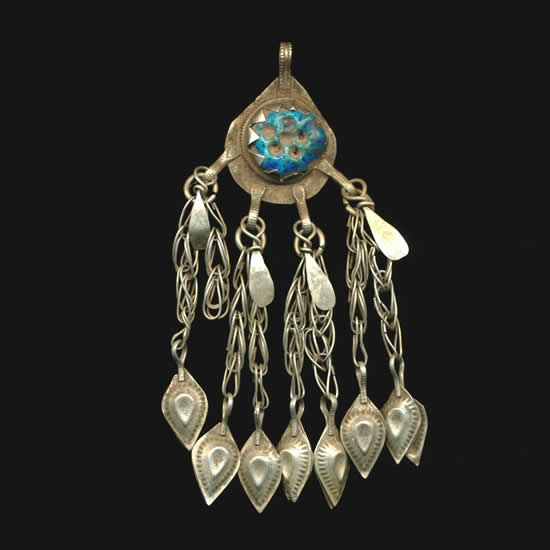
Faience and Jewelry
![]() |
| Kuchi pendant with faience 'jewel' |
If you've ever been to see exhibits of ancient Egyptian artifacts, you've probably seen examples of faience, the lovely blue to blue-green ceramics and items of jewelry. Faience was a technology discovered and refined beginning in the early Egyptian dynastic periods. (Egyptian faience should not be confused with the earthenware of the Faenze region of Italy, now more commonly known as ‘majolica’). It was probably developed to resemble the precious stone colors of turquoise and lapis lazuli. Faience was known as “tejhnet” which meant brilliant or dazzling. Faience objects were fairly common in ancient Egypt until the late Arab period in the 14th century.
As general definition, faience, or Egyptian paste, is a glassy substance manufactured by grinding quartz or sand crystals together with various amounts of sodium, potassium, calcium, magnesium, and copper oxide. The resulting substance was formed into whatever shape was desired, usually beads, amulets or other small items such as scarabs or game pieces, and then heated. During heating, the pieces would harden and develop a bright color with a glassy surface. These same substances have also been found to have been used as a glaze over other, more standard mixtures of ceramics.
As with most other early Egyptian arts, the technology and production of faience went through periods of refinement and decline during the dynastic periods of ancient Egypt. Archaeologists have found the remains of workshops where faience artists produced beautiful objects for everyday and ritual use. Faience beads and Shabti dolls have been found in many royal dynastic tombs.
![]() |
| Faience hippo god statuette |
Faience remained popular through the Middle Ages, but the appearance of cheap porcelain around the latter part of the 18th century began to lessen the demand. By the middle of 19th century, stoneware had also taken over the market for faience, leaving the art form more or less a thing of the past.
Some faience is still made today by ceramic makers, jewelers and to make small items for the tourist trade. A modern example is shown in the first photo above, a Kuchi pendant from Pakistan. You can sometimes find similar items for sale at The Red Camel.
Faience is one of those very old technologies that seem to have a place out of time. Intriguinginly, it may play a part in the pioneering field of 3D printing of ceramics.
Wednesday, September 5, 2012
Kuchi Jewelry
![]() |
| Detail of old Kuchi choker with beadwork |
Kuchi jewelry has been a favorite of tribal belly dancers since, well, since tribal belly dance began. These beautiful pieces with colorful glass jewels originally came from the nomadic tribes that wandered the border areas of Afghanistan and Pakistan, moving along ancient routes between the seasons. The word Kuchi itself is derived from a Persian word meaning migration, in relation to nomads or gypsies, and does not describe a particular group or people, but rather a state of being. The jewelry of these wandering peoples incorporates design elements from many cultures including those of India, the Middle East, Central Asia and the tribal areas of the former Soviet Union. These jewelry artists used coins, bells, and large colorful glass jewels to produce lovely chokers, necklaces, cuff bracelets, pendants, belts, rings, earrings, headpieces and more completely by hand, often in centuries-old designs. These pieces sometimes incorporated beadwork or embroidery.
As with many tribal cultures, jewelry makers were most often men and produced jewelry for families or individuals on request or for sale. They used the highest quality components available or that the family could afford. Older pieces were made in good grades of silver whenever possible, sometimes up to 90% and more, but if silver was not available or affordable, they used whatever metals were convenient. These might include nickle, brass, tin or other base metals as well as coins. The metal was melted down to make new pieces of flashing jingling finery that were worn by the women of the tribes for ceremonies and everyday purposes or decorated their animals for protection and luck. The women would then often add beautiful beadwork or embroidery to add color and functionality.
Over the centuries, and most recently in particular, these nomadic tribes have become more settled and don't travel over the great distances that they did long ago. Wars, droughts, borders and poverty have forced them to stay within ever decreasing ranges. These days most of the people once thought of as 'Kuchi' are now settled in towns and villages where they can make a more substantive living. Young people, too, don't wish to live a semi-nomadic life and prefer to live in areas where they can find jobs and a wider social life. The interest in jewelry making is now almost exclusively done for profit and trade with others outside their culture. Unfortunately this means that where pieces were once all well designed and made with care, the quality can now vary greatly from artist to artist, place to place and even piece to piece.
Trade with the US and other western countries has made the original old pieces a scarcity these days. They can still be found, but usually have a high price attached to them, especially if they are silver. Good quality collectible pieces can still be found once in a while and new pieces abound in both high and low prices and quality. A quality piece, whether new or old, can be told by a nice design, a good feel and quality construction. If you have a question about the value of a piece, do some research before buying or purchase from a reputable dealer where you can make returns if you change your mind or are not satisfied.
You can see examples of some of these pieces at The Red Camel. The Red Camel has been dealing in tribal Kuchi jewelry since 2003 and has built a great reputation within the belly dance community. Please visit my web site or see my other blog entries for more information!
Update: Shown below is an example I found on the web of a new Kuchi choker being incorrectly listed as an old or vintage piece of jewelry. It very well could have been made by Kuchi craftsmen, but this is a NEW lightweight choker that the seller has listed as an antique piece and is being sold at a very high price! These new pieces can be well-made and can look nice, and many are made by Kuchi craftsmen, please just be aware of what you are buying!!
Tuesday, October 4, 2011
Kuchi Beadwork
![]() |
| Beaded medallions from Afghanistan |
Beadwork has played an important part in decoration and ceremony in Afghanistan since very ancient times. There are many different cultural groups who live in the region that is now divided into Afghanistan, Pakistan, northern Iran and Turkmenistan. These peoples were mostly nomadic, now tending to stay in one area because of warfare, strife and political unrest. However decoration, protection and tribal identification remain very important and beadwork is still an art form in most of these areas.
The round beaded medallions that many dancers have incorporated into their costuming are traditionally called gul-i-peron or beaded ‘gul’. They are made on small circular pieces of felt or leather decorated with seed beads, shells, mirrors, etc. and attached to dresses, bags, animal harness and many other items. Gul and other beadwork are found almost anywhere there is space for adornment and come in an infinite variety of sizes and more recently a variety of shapes. Usually made in traditional colors and patterns, they are still produced by hand today.
Lots of examples of Kuchi beadwork are listed at The Red Camel in the beadwork category.
For more information, see:
Harvey,Janet (1996)Traditional Textiles of Central Asia. London: Thames and Hudson.
Kalter,Johannes (1983)The Arts and Crafts of Turkestan. London: Thames and Hudson.
You Say Talhakimt, I Say Tanfouk...
![]() |
| Red talhakimt |
Have you ever seen these and wondered what they were and where they come from? These beautiful little pieces are called talhakimt or tanfouk and are worn in Mali and Mauritania in the Sahara and West Africa as hair ornaments and pendants. This design originated in India in the 1800s but was produced in pressed glass in Czechoslovakia for African trade beginning in the early 1900s.
They come in many colors, including the red, blue and green you may have seen, plus yellow, light blue, white and black and many different shades. Some colors and materials are much more rare than others and can be very expensive. You can find these in a variety of sizes from very tiny to over 3 inches in length. Some are even made of metal or beautiful natural agate. For examples, see the Red Camel's selection of talhakimt here near the bottom of the page.
![]() |
| Talhakimt can be made of glass, agate or other materials |
Thursday, August 11, 2011
Working with Coins
![]() |
| Tribal Coins with loops |
This is a topic that I've covered on The Red Camel's FaceBook page, but it's worth repeating because I think its a good tool for those that make or embellish their own tribal costumes.
Using coins to decorate your dance costumes is quick and easy. Coins add shine, sometimes a bit of noise and are the original tribal decoration! Coins can have loops that thread either from front to back or side to side, or simply have holes drilled through. Most coins used for belly dance costumes are either newly made reproductions (easily told by the light weight), or are real Indian or middle eastern coins, usually Pakistani, Afghani or Persian. Real coins can generally be told by the older patina and heavier feel. Moroccan coins are seen less often, and some of these are small and lightweight, but most are larger and look and feel like 'real' coins. There are also other real and reproduction coins available. Any of these can be used for costuming and methods for attaching are generally the same for all.
Coins with drilled holes can be sewn directly to your costume. If you want to use jump rings, you can attach them to chain or some kind of cord and either sew the chain/cord down for a nice even row, or let it drape over the belly or swag around the hips.
Middle Eastern coins are the most plentiful for costuming and have wide loops soldered to them that thread from side to side. Indian coins can have wide, side-to-side loops or can have smaller loops that thread front to back. The smaller front-to-back loops can be sewn directly to your costuming piece with relative ease. The loops are small enough that the coins don't move around too much and will stay in place fairly well.
Coins with wide side-to-side loops are better off strung on a cord of some type to help keep them in place when they are attached and thus give a more consistent look. Sometimes you can find coins that have been removed from old clothing and decorative items that are still on their original cords. The added bonus of this is that these coins are usually all the same size and shape and are already spaced out fairly evenly along the cord. Most old cords are either rolled fabric or are a flat braided cord, sometimes consisting of two or three separate strands sewn together.
These are a breeze to just sew directly to your costume. The cords can be cut to any length, generally without having to worry that they will come undone. Just giving it a few stitches along the end is enough to keep them from unraveling. If the cords aren't the right color, try throwing them into a pot with some RIT dye!
Coins with wide loops that have already been removed from their original cords can easily be restrung. The easiest way I have found to do this is to braid some yarn and run it through the loops. The best yarn to use is the cheap stuff from a craft store. Added plus, it comes in every color! Use 6 pieces of yarn, 2 in each strand, to make a cord that fills the loops and holds the coins in place well. Make the braid a little bit longer than you need for your project. Then take a piece of scotch tape and roll it around the loose ends, like a shoelace end. This will easily pass through the loops on the coins and prevent the braid from coming undone. After your coins are strung, sew the cord down, evenly spacing the coins. Don't forget to cut off the tape and secure the ends of your braids well so they don't fray.
For an interesting variation, try alternating large and small coins in a row or making a pattern with various sizes and shapes.
That's just about everything you need to know about using coins. They're a super easy way to add tribal decoration to your costumes!
You can find real coins for tribal bellydance costuming here at The Red Camel's website.
Tuesday, August 2, 2011
What's so Fun About Tribal Jewelry?
![]() |
| Olami Cuffs from Afghanistan |
You mean apart from wearing it and feeling like you're connected to a tradition much much older than yourself? Well, for me the most fun is hunting for those old authentic well-loved pieces. The ones that are worn smooth from being touched many times, either because they are a much-loved family treasure, handed down from mother to daughter, or rubbed for protection against evil forces or simply for luck. The ones that are well made, well designed and lovely both to look at and to wear. The ones that have meaning in every detail. There is nothing quite like the feel of old tribal silvery jewelry under your fingers.
My love affair with tribal jewelry began when I was still pretty new to belly dance. I danced with a troupe that was mostly cabaret style ('sparkly girls' for those who are unfamiliar with the term) instead of tribal. But I began to really love this jewelry when we danced at ren faires and I was free to wear tribal jewelry and incorporate those elements into my costuming. I loved hunting down just the right pieces and making something very special out of them.
So as I continued to dance I continued to look for these pieces everywhere I went. Thrift stores, flea markets, estate sales, around town, on vacation - wherever my destination was. I loved finding these beautiful items so much that my house soon abounded with them and it was time to do something about it. That's how The Red Camel was born.
Now I still get to shop for that perfect piece of tribal jewelry. Anywhere. Everywhere! And I still have a spare bedroom. Although I must confess that I do keep some of the very best pieces for myself. But I can't keep it all and you may be the next lucky benefactor of my delight in rooting these pieces out of their secretive hiding spaces.
See what I've found here: www.redcamel.net
Subscribe to:
Posts (Atom)